On this page
Build a profile of trainable capacities and task constraints. Use anatomy to understand options, not to declare the outcome of a career before the athlete has trained.
Specific strength is more informative than size alone
Larger muscles can support greater force production, but whole-body appearance is not a direct test of armwrestling ability. The comparison of nine armwrestlers with nine strength-trained men found differences in specific elbow-flexor performance and forearm circumference, rather than a simple rule that the visibly bigger person must win. Maximum force, the position in which it is expressed and how it is transferred through the hand all belong in the profile. A laboratory advantage is still not a complete competitive prediction. [1]
Timing and technique change how capacity is used
A competitor must develop force while reacting to an opponent and maintaining useful positions. Early force production is therefore relevant alongside maximum force. Studies of elite armwrestlers show different strength-time profiles, while competition research also examines perceptual characteristics. These observations support measuring more than one quality; they do not identify one universal ideal profile. RFD, reaction time and learned technical decisions should also remain distinct rather than being collapsed into a single concept of “speed”. [2, 3, 4]
Performance has several interacting dimensions
Maximum and position-specific force
Reaction and early force
Position and opponent interaction
Loading tolerance and adaptation
Hand, segments and moment arms
Training, recovery and learning
Tendons and geometry matter, but simple stories overreach
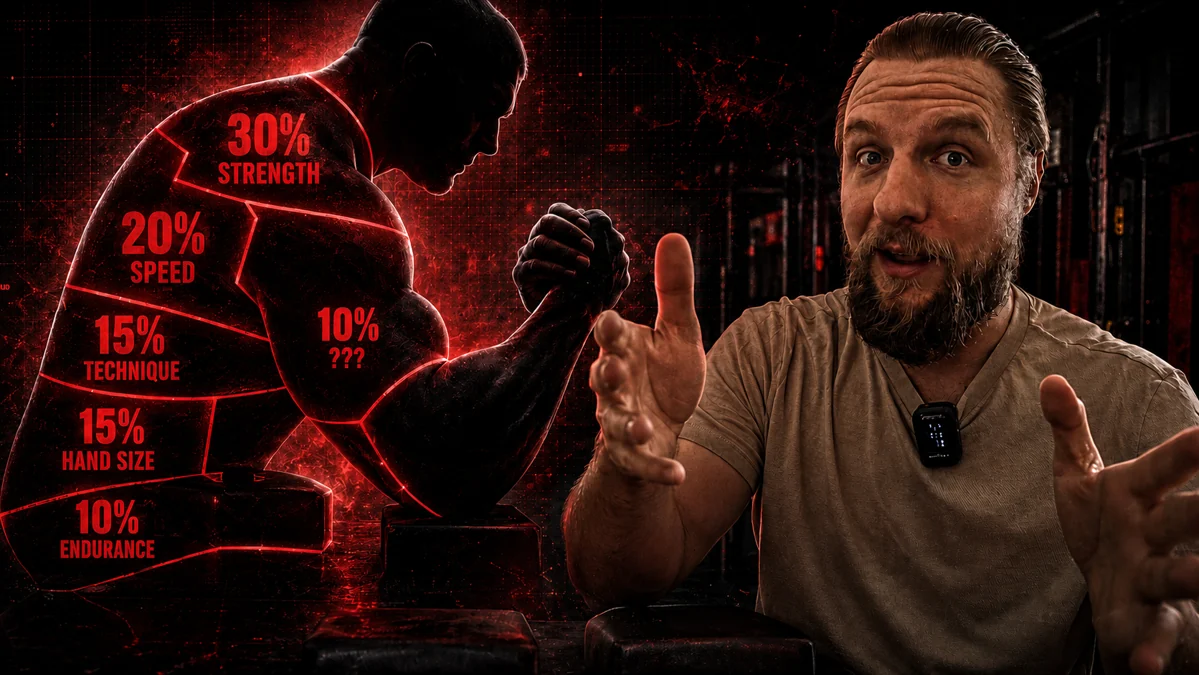
Tendon properties influence force transmission, and human loading studies show that stiffness and material properties can adapt. That does not mean the stiffest possible tendon is always optimal, or that a successful athlete’s tendon properties can be inferred from video. Hand dimensions, segment lengths and moment arms change the mechanical problem. They may create advantages in some positions and trade-offs in others. Current evidence does not justify assigning fixed percentages of success to genetics, tendons, muscle size or any other category. [1, 2, 5]
Turn a profile into priorities
The productive application is to identify the factor currently limiting a repeatable task: maximum force, early force, positional control, technical execution or the ability to recover from training. Work on a small number of priorities and then reassess both the tests and table performance. Consistency and patience make such learning possible, but they are not a quantified formula for winning. Avoid diagnosing fibre type from one dynamometer trace, attributing ability to ethnicity, or treating body structure as proof of an unchangeable ceiling. [3, 4]
What this does not tell us
No supplied study estimates the relative contribution of every factor to match outcomes. The visual map is an editorial framework, not a validated prediction model, a genetic assessment or a ranking of named athletes.
Source materials
RFD in armwrestling: research reportPDF in English · 11 pagesTendons & isometrics: visual evidencePDF in English · 9 pagesReferences
Based on the supplied English video transcript and the sources below.
- Coletta F, Cesanelli L, Kamandulis S, Conte D. (2025). Comparative Analysis of Elbow Flexor Morphology, Physiology, and Performance Between Arm Wrestlers and Strength-Trained Athletes. Journal of Strength and Conditioning Research. 39(5):579–586.
- Akpinar S, et al. (2013). Anthropological and Perceptual Predictors Affecting the Ranking in Arm Wrestling Competition. International Journal of Morphology. 31(3):832–838.
- Bezkorovainyi D, Kamayev O, Vlasko S, et al. (2023). Comparative Analysis of the Efforts of Highly Qualified Elite Armwrestlers with Different Strength Abilities. Physical Education Theory and Methodology. 23(6):850–859.
- Maffiuletti NA, Aagaard P, Blazevich AJ, Folland J, Tillin N, Duchateau J. (2016). Rate of force development: physiological and methodological considerations. European Journal of Applied Physiology. 116:1091–1116.
- Lazarczuk SL, et al. (2022). Mechanical, Material and Morphological Adaptations of Healthy Lower Limb Tendons to Mechanical Loading: A Systematic Review and Meta-Analysis. Sports Medicine. 52:2405–2429.