
On this page
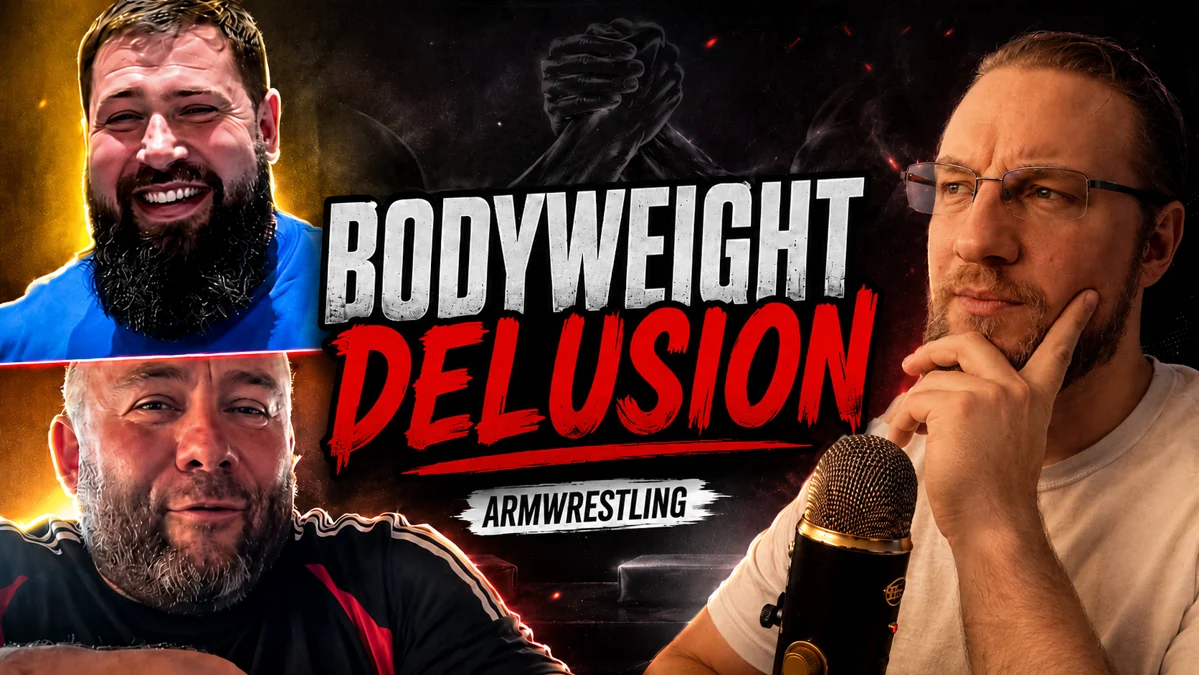
Build a sustainable diet around sufficient energy and protein. Adjust it to your training response and weight-class goals, rather than assuming the fastest weight gain produces the best armwrestler.
Body mass is an outcome, not the training goal
The practical point of the narration is that eating more and becoming a better competitor are not the same thing. A fixed surplus cannot guarantee that the added weight is useful muscle. Treat any calorie target as a starting estimate and examine trends in body mass, training quality and recovery over time. This is a monitoring strategy, not an experimentally proven armwrestling-specific calorie formula. Weight-class constraints and the athlete’s starting position change the decision; neither aggressive bulking nor chronic under-fuelling is a universal solution. [3]
What the familiar protein number means
Morton and colleagues pooled 49 resistance-training studies involving 1,863 participants. Their analysis estimated a breakpoint around 1.62 g protein per kilogram of body mass per day for additional fat-free-mass gains, with a broad 95% confidence interval of 1.03–2.20. This is a group-level estimate, not a precise ceiling applying to every person or a safety limit. About 1.6 g/kg/day can be a useful planning reference for a healthy exercising adult, while individual context still matters. [1]
A reference point is not a hard ceiling
View the values
| FIGURE | Estimate | 95% confidence interval |
|---|---|---|
| Estimated breakpoint | 1.62 | 1.03 - 2.20 |
Do not make the rest of the diet disappear
Protein does not replace sufficient total energy, varied food or a pattern that supports regular training. The film’s suggested calorie, carbohydrate and fat quantities are practical opinions, not universal physiological boundaries established by the cited protein meta-analysis. A mixed or plant-based approach needs to meet the same underlying nutritional needs; the label alone does not establish quality. When energy restriction, a medical condition or a difficult weight cut is involved, individual dietary advice is more appropriate than copying a channel-wide number. [1, 3]
Supplements belong after the foundations
A protein supplement is one way to fill a dietary gap, not a separate route around training. Collagen needs additional nuance: a positive patellar-tendon trial compared added collagen protein with carbohydrate, while both groups received vitamin C. It therefore does not show that collagen is superior to an equivalent serving of complete protein for every purpose. Nor did that trial show additional strength or power gains. Keep the question specific: muscle development, dietary convenience and tendon adaptation are different outcomes. [1, 2]
What this does not tell us
Most evidence comes from general resistance training rather than armwrestling. The proposed monitoring approach is an editorial application, not a tested meal plan. Individual requirements may differ with age, health, training load and energy restriction.
Source materials
Collagen, vitamin C & protein: final reportPDF in English · 27 pagesReferences
Based on the supplied English video transcript and the sources below.
- Morton RW, et al. (2018). A systematic review, meta-analysis and meta-regression of the effect of protein supplementation on resistance training-induced gains in muscle mass and strength in healthy adults. British Journal of Sports Medicine. 52:376–384.
- Nulty CD, Phelan K, Erskine RM. (2025). Hydrolysed Collagen Supplementation Enhances Patellar Tendon Adaptations to 12 Weeks’ Resistance Training in Middle-Aged Men. European Journal of Sport Science. 25:e12281.
- Meeusen R, et al. (2013). Prevention, diagnosis, and treatment of the overtraining syndrome: joint consensus statement of the European College of Sport Science and the American College of Sports Medicine. Medicine & Science in Sports & Exercise. 45:186–205.