On this page
Interpret side pressure through joint moments, position and coordinated force transmission. Elbow stability is part of the problem, but it is not a complete definition of the whole competitive action.
Start with the external task
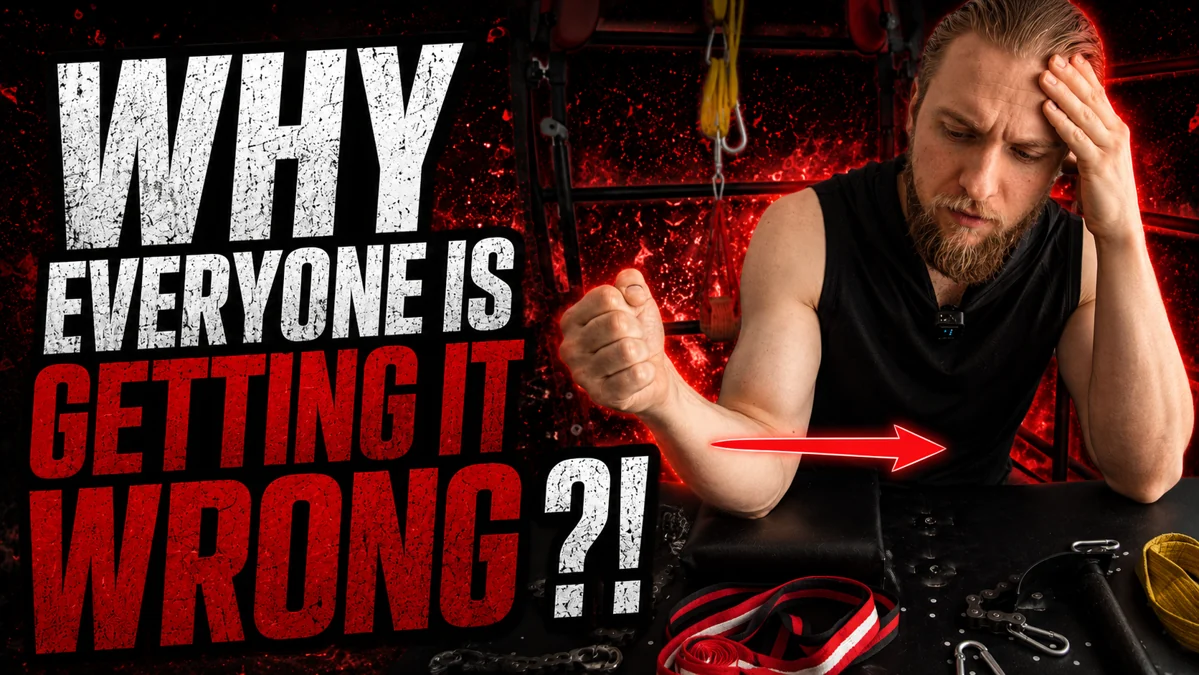
At the table, force is applied through the hand while the elbow, shoulder and trunk organise the position. A sideways result can involve several joint actions and stabilising demands. The narration places emphasis on resistance to valgus at the elbow. That is a useful local perspective, but it is too narrow to explain all side-pressure performance: the shoulder’s internal-rotation demand and the geometry of the whole upper limb also matter. Descriptions should distinguish the direction of external force from the action of an individual muscle. [1]
A force number needs a moment arm
The turning effect of a force is its moment: force multiplied by the perpendicular distance from the relevant axis. In a simple illustrative model, 100 N acting at 0.20 m creates 20 N·m; at 0.30 m it creates 30 N·m. This is why a change in position can alter the demand without changing the external force. It is not a calculation of actual elbow-ligament loading, because a living joint has several interacting structures and three-dimensional geometry.
Same force, different turning effect
| Force | Moment arm | Moment |
|---|---|---|
| 100 N | 0.20 m | 20 N·m |
| 100 N | 0.30 m | 30 N·m |
moment_Nm = force_N * perpendicular_moment_arm_m
Muscles and passive structures share the task
Muscles generate active force, tendons transmit it and ligaments contribute to passive stability. The contribution of each depends on position and loading; losing a particular hand action does not establish that all load suddenly passes through one ligament. Injury literature in armwrestling describes substantial torsional and bending demands, including humeral fractures and less common soft-tissue injuries. Reports of injured patients cannot estimate the probability of injury for every participant, but they make clear that “feels stable” is not a complete safety test. [1]
What can be applied without inventing an exercise tutorial
A defensible training discussion specifies the intended joint position, force direction, controllable load and progression. Isometric adaptations depend partly on the conditions trained, so a number from one setup should not be assumed to transfer unchanged to every table position. This article does not translate the film’s visible angles into a written maximal-load prescription. The broader lesson is to develop a coordinated, repeatable task and learn it under competent supervision, rather than deliberately rely on passive structures as the principal strategy. [1, 2]
What this does not tell us
The mechanical example is deliberately simplified. It does not locate a person’s pain, identify an injured structure or establish a safe load. Sudden injury, marked weakness or joint instability requires assessment, not an online anatomical guess.
References
Based on the supplied English video transcript and the sources below.
- Moloney DP, Feeley I, Hughes AJ, Merghani K, Sheehan E, Kennedy M. (2021). Injuries associated with arm wrestling: A narrative review. Journal of Clinical Orthopaedics and Trauma. 18:30–37.
- Oranchuk DJ, Storey AG, Nelson AR, Cronin JB. (2019). Isometric training and long-term adaptations: Effects of muscle length, intensity, and intent: A systematic review. Scandinavian Journal of Medicine & Science in Sports. 29:484–503.